

Why is Copper Core PVC Insulated Sheathed Flexible Control Cable Preferred Over Aluminum Core for Signal Integrity in Automated Machinery
2026-05-14
In modern automated machinery, signal integrity determines production accuracy, fault diagnosis speed, and overall system reliability. Yilan has observed a consistent industry shift: engineers increasingly choose Copper Core PVC Insulated Sheathed Flexible Control Cable over aluminum alternatives for critical signal transmission paths.
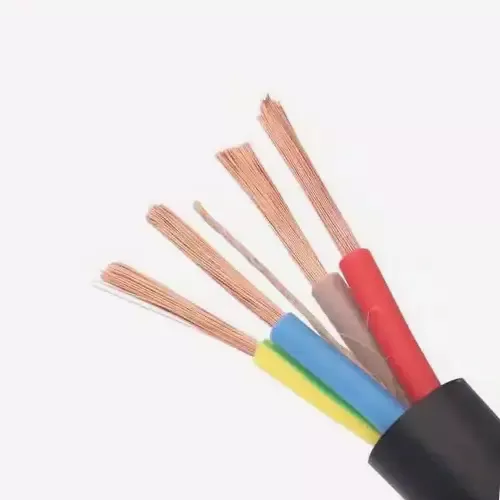
The Core Difference: Conductivity and Signal Fidelity
| Parameter | Copper Core | Aluminum Core |
|---|---|---|
| Electrical conductivity (% IACS) | 100-101% | 61-63% |
| Resistance per 1,000 ft (AWG 16) | ~4.02 Ω | ~6.60 Ω |
| Signal attenuation over 50 m | Low | 35-40% higher |
| Cyclic bending life (1 million cycles) | Stable signal | Intermittent dropouts |
The higher resistance of aluminum creates voltage drops that distort low-voltage control signals such as encoder feedback or PLC inputs. In automated machinery where microsecond timing matters, Copper Core PVC Insulated Sheathed Flexible Control Cable maintains signal shape and amplitude without error-inducing attenuation.
Mechanical Flexibility Under Continuous Motion
Automated pick-and-place machines, robotic arms, and conveyor systems demand cables that flex thousands of times daily. Copper strands tolerate repeated bending better than aluminum, which work-hardens and fractures. Yilan designs its Copper Core PVC Insulated Sheathed Flexible Control Cable with fine-stranded copper (Class 5 or 6) to withstand torsional stress while preserving characteristic impedance – a property aluminum cannot match.
Why Aluminum Fails in Noisy Industrial Environments
Aluminum’s higher resistivity makes it more susceptible to electromagnetic interference (EMI). When bundled with motor cables or variable frequency drives, aluminum conductors pick up noise that corrupts data signals. Copper’s natural shielding effect, combined with PVC insulation, provides passive EMI rejection. The PVC sheath of Copper Core PVC Insulated Sheathed Flexible Control Cable adds mechanical protection without increasing signal reflection.
Common Applications Where Copper Excels
-
Servo motor feedback loops – Requires real-time position data without jitter
-
Analog sensor connections – 4-20 mA loops degrade less with copper’s lower loop resistance
-
High-speed I/O networks – Maintains edge rise times for fieldbus protocols like Profibus or DeviceNet
Frequently Asked Questions
What happens if I use aluminum core cable for a moving robotic arm application?
Aluminum conductors develop micro-cracks after 50,000 to 100,000 flex cycles, causing intermittent signal loss or high-resistance shorts. Copper strands endure over 10 million cycles in Yilan cables. Aluminum’s lower tensile strength also leads to premature breakage at termination points, requiring costly machine downtime every few months.
Does the PVC insulation impact signal integrity differently for copper versus aluminum conductors?
No, but the conductor material magnifies insulation effects. PVC has a dielectric constant of 3–5, which creates capacitance per unit length. With aluminum’s higher resistance, this capacitance forms a low-pass filter that smears digital signal edges. Copper’s lower resistance shifts the cutoff frequency far above typical automation signaling rates (≤10 MHz), preserving waveform fidelity.
How do I verify that a Copper Core PVC Insulated Sheathed Flexible Control Cable meets my machine’s signal requirements?
Check three specifications: conductor stranding (Class 5 or 6 minimum), nominal resistance (match original copper-based design), and shield type if EMI is present. Yilan provides tested impedance data and flex-life reports. For critical signals, request an eye pattern test or time domain reflectometer (TDR) scan to confirm no impedance mismatches.
Conclusion
Choosing Copper Core PVC Insulated Sheathed Flexible Control Cable over aluminum for automated machinery is not about cost – it is about predictable signal integrity, longer uptime, and lower total ownership cost. Yilan engineers every cable to meet the mechanical and electrical demands of Industry 4.0 environments.
Contact us today for a custom signal integrity assessment and sample testing on your specific automated machinery application.