

What Are the Key Standards and Specifications for Low Relaxation Prestressed Concrete Steel Wire
2026-11-13
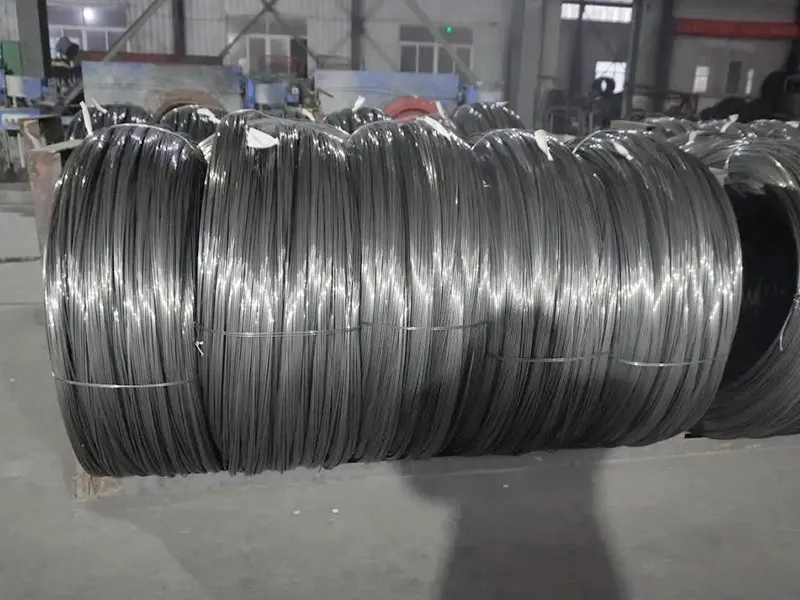
Engineers specifying tensioned reinforcement for bridges, silos, and nuclear containment structures need a reliable reference point for compliance. Low Relaxation Prestressed Concrete Steel Wire is governed by a layered system of international standards, each defining chemistry, geometry, mechanical performance, and relaxation limits. Luguan Xingsheng manufactures wire to these frameworks and supports project teams in mapping client specifications onto the correct standard. This guide consolidates the requirements that matter most during design review and procurement.
Why Relaxation Classification Drives Every Specification
Relaxation is the loss of tension under sustained strain. Standard prestressing wire is typically rated at 2.5% relaxation after 1,000 hours, while Low Relaxation Prestressed Concrete Steel Wire is held to 1.0% or lower at 70–80% of ultimate tensile strength. That single percentage difference governs anchorage design, camber prediction, and long-term serviceability, so every major standard treats relaxation as a primary classification rather than an optional property.
Core International Standards Compared
| Standard | Region | Typical Wire Grades | Min. Tensile Strength | Relaxation Limit (1,000 h) | Key Focus |
|---|---|---|---|---|---|
| ASTM A421 / A421M | North America | Grade 250, 270 | 1,720–1,860 MPa | 1.0% at 70% UTS | Low-relaxation designation, dimensional tolerances |
| EN 10138-2 | Europe | Y1560C, Y1670C, Y1770C | 1,560–1,770 MPa | 1.0% at 70% UTS (Class 2) | Full conformity and factory production control |
| ISO 6934-2 | International | Type B, low-relaxation | 1,570–1,860 MPa | 1.0% at 70% UTS | Testing methodology and batch verification |
| GB/T 5223 | China | 1570, 1670, 1770 | 1,570–1,770 MPa | 1.0% at 70% UTS | Domestic certification and traceability |
| AS/NZS 4672 | Australia/NZ | Class 2 | 1,700–1,860 MPa | 1.0% at 70% UTS | Seismic and durability provisions |
Essential Technical Requirements
-
Chemical composition: Controlled carbon and manganese levels, with strict limits on phosphorus and sulfur to preserve ductility.
-
Surface condition: Free of cracks, scale, and harmful defects; indentations or spiral patterns must meet defined profile tolerances.
-
Diameter and ovality: Tolerances typically within ±0.05 mm for 4–7 mm wire, verified by laser gauging.
-
Mechanical properties: Yield strength at 0.1% offset, elongation at break, and bend performance tested per batch.
-
Relaxation testing: Isothermal tests at 20°C for 1,000 hours, with accelerated extrapolation permitted under ISO 15630-3.
-
Fatigue resistance: Stress range verification for dynamically loaded structures such as railway bridges.
Documentation and Quality Assurance
Compliance is only as strong as the paperwork behind it. Luguan Xingsheng supplies mill test certificates, third-party relaxation reports, and full heat-number traceability with every shipment of Low Relaxation Prestressed Concrete Steel Wire. Buyers should confirm that certificates reference the exact standard edition, since revisions to ASTM A421 and EN 10138 have altered sampling frequencies and acceptance criteria.
Frequently Asked Questions
What relaxation value qualifies wire as low relaxation? A maximum of 1.0% loss at 1,000 hours under 70% of ultimate tensile strength is the common threshold across ASTM, EN, ISO, and GB standards, though some specifications require 2.5% for standard wire as a contrast baseline.
Can low relaxation wire be substituted for strand in post-tensioning? Yes in many systems, but the substitution requires rechecking anchorage geometry, wedge compatibility, and elongation calculations, because wire and strand differ in diameter, surface profile, and modulus of elasticity.
How often should relaxation testing be repeated during production? Most standards require type testing at initial qualification and periodic audit testing, commonly every six months or per defined production volume, with each heat or lot subject to tensile and dimensional checks.
Which standard should govern an export project? The governing standard is normally set by the structural designer and local authority; where multiple standards apply, Luguan Xingsheng can dual-certify Low Relaxation Prestressed Concrete Steel Wire to satisfy both client and regulatory requirements.
Send your project specification, wire diameter, and target standard to Luguan Xingsheng, and our engineering team will return a compliance matrix, test documentation, and quotation within two working days. Partner with us to secure certified Low Relaxation Prestressed Concrete Steel Wire for your next structure.