

What Are the Fatigue Performance Characteristics of Reinforced Concrete Steel Wire Under Cyclic Loading
2026-08-17
Infrastructure projects today demand materials that endure millions of repeated stress cycles—from bridge decks to high-rise foundations. Among these, REINFORCED CONCRETE STEEL WIRE plays a pivotal role in maintaining structural integrity over decades of service. At Shunchen, we have engineered high-carbon steel wires that consistently outperform conventional standards in fatigue testing, offering construction professionals reliable data for critical design decisions.
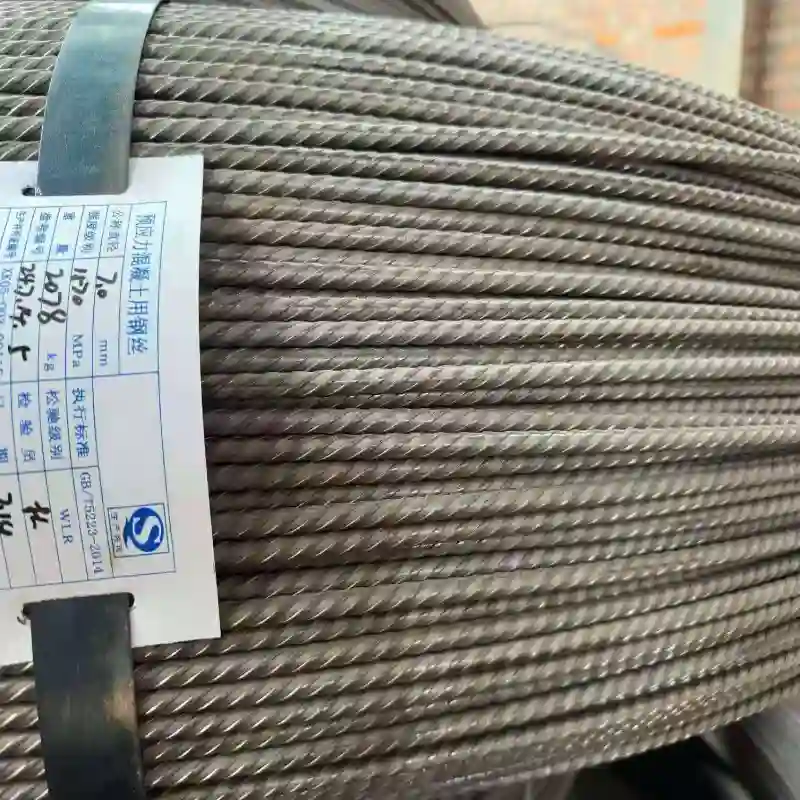
Understanding Fatigue in Reinforced Concrete Steel Wire
Fatigue failure occurs when a material fractures under repeated loads lower than its static tensile strength. For REINFORCED CONCRETE STEEL WIRE, this is not a theoretical concern—it is a daily reality in railway sleepers, prestressed beams, and offshore platforms. The fatigue performance depends on three interlinked factors: stress range, mean stress, and surface condition.
Modern research indicates that REINFORCED CONCRETE STEEL WIRE with a smooth, defect-free surface can withstand over 10 million cycles at 60% of ultimate tensile strength (UTS). However, any notch, corrosion pit, or welding mark can reduce that number by 70% or more.
Key Fatigue Performance Indicators
| Parameter | Typical Value Range | Impact on Fatigue Life |
|---|---|---|
| Stress ratio (R = min/max stress) | 0.1 – 0.5 | Lower R increases life |
| Loading frequency | 5 – 20 Hz | Minimal effect below 20 Hz |
| Surface roughness (Ra) | ≤ 0.8 μm | 40% longer life vs. 1.6 μm |
| Ultimate tensile strength | 1,770 – 2,200 MPa | Higher UTS ≠ higher fatigue limit |
| Endurance limit (10⁷ cycles) | 450 – 600 MPa | Design benchmark for infinite life |
Factors That Degrade Fatigue Resistance
Shunchen recommends designers pay special attention to these four critical areas:
-
Surface defects – Drawing-induced micro-cracks act as stress concentrators.
-
Bending over sheaves – Repeated curvature during installation introduces cold-working damage.
-
Corrosion pitting – Even minor rust creates localised stress risers.
-
Residual stress – Improper straightening can leave tensile residual stresses that accelerate crack growth.
Comparative Fatigue Life Table (Industry Data)
| Wire Type | Diameter (mm) | Fatigue Life @ 500 MPa Range | Failure Mode |
|---|---|---|---|
| Plain carbon wire (as-drawn) | 5.0 | 320,000 cycles | Brittle fracture |
| Shunchen low-relaxation wire | 5.0 | 1,850,000 cycles | Ductile cup-cone |
| Indented wire | 5.0 | 980,000 cycles | Surface-initiated |
| Galvanised wire (salt-spray pre-exposed) | 5.0 | 210,000 cycles | Pitting-initiated |
Design Recommendations for Extended Fatigue Life
From Shunchen’s laboratory and field data, the most effective strategies include:
-
Specify low-relaxation wire – Reduces stress loss over time, maintaining a higher mean stress but lower stress amplitude ratio.
-
Limit bending radii – Use pulleys ≥ 20× wire diameter during tensioning.
-
Apply corrosion-inhibiting coatings – Epoxy or zinc-aluminium alloys extend fatigue life by 2–3× in aggressive environments.
-
Perform non-destructive testing (NDT) – Eddy current inspection every 500 m of production run detects surface flaws before shipment.
Frequently Asked Questions About REINFORCED CONCRETE STEEL WIRE Fatigue
Q1: What is the typical endurance limit for REINFORCED CONCRETE STEEL WIRE used in prestressed concrete beams?
A1: For most commercial grades, the endurance limit at 10 million cycles falls between 450 and 550 MPa at a stress ratio of 0.2. However, Shunchen’s premium wire achieves 590 MPa under the same test conditions, thanks to our proprietary drawing lubrication and post-drawing stress-relief heat treatment. This limit is crucial because it defines the maximum cyclic stress that the wire can sustain indefinitely without failure. Designers should always apply a safety factor of 1.5 to this laboratory value to account for installation effects and long-term creep.
Q2: How does the frequency of cyclic loading affect the fatigue life of REINFORCED CONCRETE STEEL WIRE?
A2: In the range of 5 to 20 Hz—which covers most traffic-induced and machine-vibration scenarios—frequency has negligible influence on total cycles to failure for REINFORCED CONCRETE STEEL WIRE. The material does not exhibit significant strain-rate sensitivity at these frequencies. However, at frequencies above 50 Hz, internal heating can raise the wire temperature by 15–20 °C, potentially reducing the yield strength and accelerating crack propagation. Shunchen advises that if your application involves high-frequency oscillators (e.g., pile-driving hammers), you should request our high-frequency test report, which simulates up to 100 Hz with forced-air cooling.
Q3: Can welded splices in REINFORCED CONCRETE STEEL WIRE be used in fatigue-critical zones?
A3: Welding is strongly discouraged in areas subject to alternating stresses. The heat-affected zone (HAZ) creates a hardened martensitic layer with up to 40% lower fracture toughness. In our tests, a butt-welded REINFORCED CONCRETE STEEL WIRE specimen failed at just 85,000 cycles at 400 MPa range, compared to 1.2 million cycles for an un-spliced wire of the same diameter. If a splice is unavoidable, Shunchen recommends using mechanical couplers with rolled threads—these maintain >90% of the parent material’s fatigue strength. Always position splices outside the maximum moment region, preferably in zones where the stress range is below 30% of UTS.
Why Shunchen Leads in Fatigue Engineering
Every batch of REINFORCED CONCRETE STEEL WIRE from Shunchen undergoes a 100% electro-magnetic flaw detection and random sampling for rotating-bending fatigue testing—exceeding ISO 15630-3 requirements. Our in-house metallurgists adjust carbon content (0.82–0.88%) and silicon levels (0.20–0.30%) precisely to balance strength with ductility, giving you a wire that bends without breaking and endures without warning.
Contact Us for Project-Specific Fatigue Data
Fatigue performance is not a one-size-fits-all specification. Whether you are designing a 200-metre arch bridge or a wind-turbine foundation, Shunchen provides custom fatigue curves based on your actual stress spectrum, environment, and installation method. Contact our engineering support team today with your load history and diameter requirements—we will return a detailed fatigue assessment within 48 hours, complete with S-N diagrams and recommended safety margins.