

How Much Current Can a Typical Copper Flex Connector Handle Safely
2026-06-25
When designing high-power electrical systems, one question consistently arises among engineers and procurement specialists: How much current can a typical Copper flex connector handle safely? The answer is not a single number—it depends on cross-sectional area, ambient temperature, plating material, and installation conditions. At Dongjue, we have tested thousands of Copper flex connector variants across EV, UPS, and switchgear applications, and we know that safe current rating is a balance between thermal performance and mechanical longevity. This blog provides data-driven guidance, practical tables, and expert FAQs to help you specify the right Copper flex connector for your next project.
The Core Formula: Temperature Rise Defines Safe Current
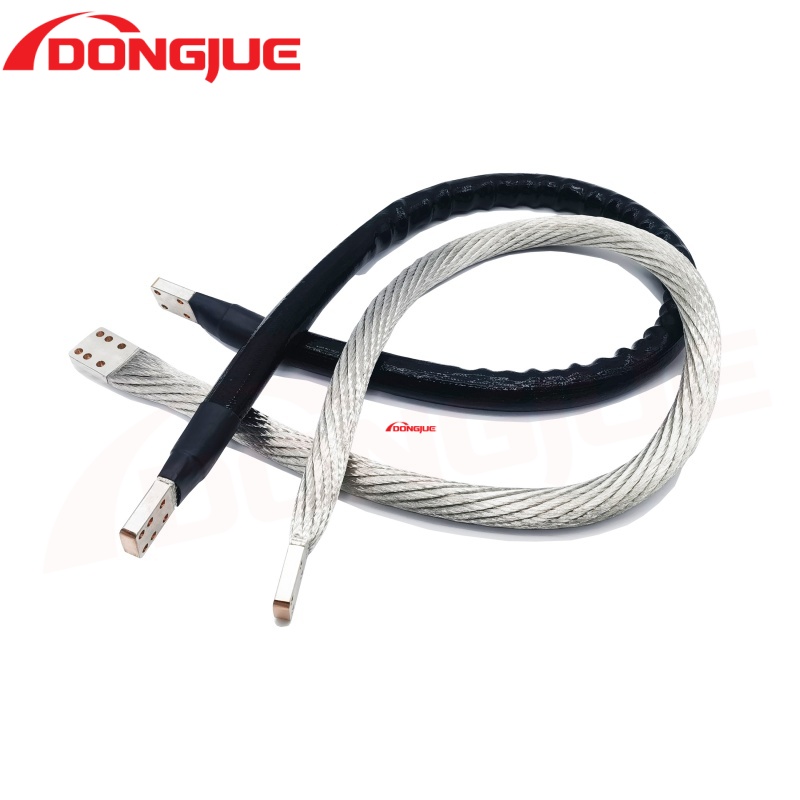
Unlike solid copper bars, a Copper flex connector consists of multiple thin lamellas stacked and welded or pressed at the ends. This laminated structure increases surface area for heat dissipation but also introduces contact resistance between layers. The safe continuous current (I) is governed by the allowable temperature rise (ΔT)—typically 50°C above a 40°C ambient for UL-compliant designs—and the connector’s DC resistance per meter.
For a standard Copper flex connector, the empirical rule of thumb is 3.5 to 4.5 Amperes per square millimeter of total copper cross-section, assuming still air and tin-plated terminations. However, forced convection, busbar clamping pressure, and termination plating significantly alter this value.
Current Rating Reference Table (Based on Dongjue Lab Data)
The following table shows conservative continuous current ratings for common Copper flex connector sizes at 40°C ambient, 50°C temperature rise, with tin-plated ends and natural convection.
| Total Copper Cross-Section (mm²) | Lamella Count (layers) | Width (mm) | Thickness per Layer (mm) | Safe Continuous Current (A) | Peak Overload (10s, A) |
|---|---|---|---|---|---|
| 25 | 15 | 20 | 0.10 | 90 – 105 | 180 – 210 |
| 50 | 20 | 30 | 0.10 | 175 – 200 | 350 – 400 |
| 100 | 25 | 40 | 0.12 | 340 – 380 | 680 – 760 |
| 150 | 30 | 50 | 0.12 | 500 – 560 | 1000 – 1120 |
| 200 | 35 | 60 | 0.12 | 660 – 730 | 1320 – 1460 |
| 300 | 40 | 80 | 0.15 | 960 – 1080 | 1920 – 2160 |
Notes: Values assume clean, bolted terminations with torque per Dongjue specification. Derate by 15–20% if ambient exceeds 50°C or if the connector is installed in enclosed, non-ventilated enclosures.
Critical Factors That Derate Safe Current
A Copper flex connector does not behave like a rigid busbar. Its flexibility introduces three unique limitations:
-
Skin effect at > 1 kHz – Laminated layers reduce AC losses, but above 1 kHz, proximity effects increase resistance. For inverter applications, Dongjue recommends using 0.08mm ultra-thin layers to mitigate this.
-
Termination resistance – Poorly torqued bolts add localized hot spots. A 20 µΩ increase at each end reduces current capacity by 8–12%.
-
Cyclic loading – Repeated thermal expansion and contraction can loosen joints over time. Dongjue uses Belleville washers and anti-rotation end plates to maintain constant pressure.
For a conservative first-pass estimate, always apply a 0.8 safety factor to the table above when designing for 24/7 industrial operation.
Copper flex connector FAQ – Common Questions from Engineers
Q: Can I use a Copper flex connector at its full table rating if I mount it vertically instead of horizontally?
A: Yes, but with caution. Vertical mounting improves natural convection along the lamella surfaces, potentially increasing heat dissipation by 5–8%. However, gravity can cause slight sagging in longer spans (>300 mm), which may reduce effective contact pressure at the upper termination. Dongjue recommends reducing the rated current by 5% for vertical installations longer than 400 mm, or using our reinforced-edge design with supporting clips. We have observed that horizontal mounting with both ends firmly bolted to identical busbar heights yields the most consistent thermal performance.
Q: How does tin plating vs. silver plating affect the safe current of a Copper flex connector?
A: Silver plating reduces contact resistance by about 30–40% compared to tin, which directly lowers I²R heating at the termination. For a 100 mm² Copper flex connector, silver-plated ends can safely carry 380–410 A continuous versus 340–380 A for tin-plated ends—a clear 10–12% improvement. However, silver tarnishes in sulfur-rich environments, while tin provides better long-term corrosion protection in outdoor cabinets. Dongjue offers both finishes, and we typically advise silver for clean indoor UPS systems and tin for wind turbine or marine applications where humidity and salt spray are concerns.
Q: What happens if I temporarily overload my Copper flex connector beyond its safe rating for 30 seconds?
A: A well-designed Copper flex connector from Dongjue can handle 2× its continuous rating for up to 10 seconds without permanent deformation, thanks to the high ductility of oxygen-free copper (C10200). For a 30-second overload at 1.5× rating, expect a temperature rise of 70–85°C above ambient. This is acceptable once or twice during motor start-up or breaker reclosing, but repeated daily overloads will accelerate annealing of the copper lamellas, reducing their spring-back property. After 50 such cycles, the connector may develop micro-gaps between layers, increasing resistance by 5–8%. We always recommend logging the number of overload events and scheduling a torque re-check after every 20 severe cycles.
Best Practices for Safe Implementation
To extract maximum safe current from your Copper flex connector, follow these Dongjue-validated rules:
-
Torque to specification – Over-torquing distorts terminal holes; under-torquing creates arcing. Use a calibrated wrench.
-
Use flexible braided jumpers for angles > 15° – If your installation requires bending, choose a braided Copper flex connector instead of laminated, as lamellas tolerate only limited deflection.
-
Monitor thermal imaging – A 15°C hotspot at one termination indicates uneven pressure. Re-torque in a star pattern.
Why Choose Dongjue for Your Copper flex connector Needs?
With over 18 years in conductive interconnection manufacturing, Dongjue provides fully customizable Copper flex connector solutions—from 10 mm² to 800 mm² cross-sections, with UL 94 V-0 insulation sleeves, nickel barrier plating, and 100% high-potential testing. Every batch includes a thermal rise test report, ensuring you receive exactly the safe current capacity you designed for.
Need a verified current rating for your unique application?
Contact Dongjue today with your ambient temperature, duty cycle, and mounting orientation—our engineering team will return a detailed thermal simulation and a free sample within 48 hours. Your project deserves a Copper flex connector that doesn't just meet specs—it exceeds them under real-world heat, vibration, and time.