

How Is Aluminum PVC Insulated Flat Wire Manufactured and What Standards Apply
2026-10-08
Aluminum PVC Insulated Flat Wire has become a preferred conductor solution for transformers, inductors, motors, and compact electrical assemblies where space efficiency and weight reduction matter. At Qiancheng, manufacturing this product is a precision-driven process that combines metallurgical control, polymer extrusion technology, and rigorous quality validation. Understanding how Aluminum PVC Insulated Flat Wire is produced—and which standards govern it—helps engineers, procurement teams, and OEMs specify the right product with confidence.
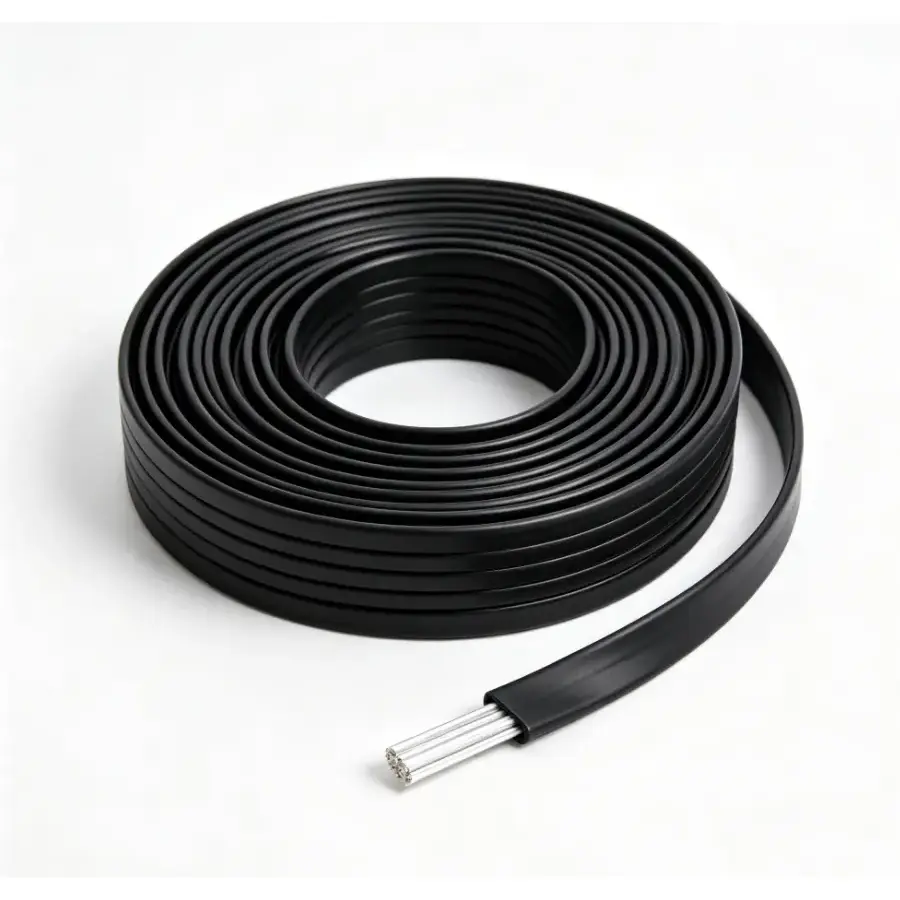
The Manufacturing Process of Aluminum PVC Insulated Flat Wire
Production at Qiancheng follows a controlled sequence from raw material to finished reel. Each stage influences electrical performance, insulation integrity, and dimensional accuracy.
-
Aluminum Rod Selection and Drawing – High-purity aluminum rods (typically 1350 or 1370 grade) are drawn down to the required cross-sectional area.
-
Flat Rolling and Shaping – The round wire passes through precision rolling mills to achieve a rectangular profile with defined width-to-thickness ratios.
-
Annealing and Softening – Controlled heat treatment restores ductility and conductivity after mechanical deformation.
-
Surface Cleaning and Treatment – Oxide layers and contaminants are removed to ensure proper PVC adhesion.
-
PVC Extrusion – The flat conductor is coated with polyvinyl chloride compound using a crosshead extrusion line, controlling wall thickness concentricity.
-
Cooling and Curing – Gradual cooling prevents internal stress and dimensional distortion.
-
Spark Testing and Inspection – Inline high-voltage spark testers detect insulation faults.
-
Cutting, Winding, and Packaging – Finished Aluminum PVC Insulated Flat Wire is spooled to customer lengths and labeled for traceability.
Key Manufacturing Parameters
| Parameter | Typical Range | Why It Matters |
|---|---|---|
| Aluminum Purity | 99.5%–99.7% | Conductivity and corrosion resistance |
| Flat Wire Thickness | 0.2 mm–5.0 mm | Fits tight winding spaces |
| Flat Wire Width | 1.0 mm–30.0 mm | Current-carrying capacity |
| PVC Wall Thickness | 0.2 mm–1.5 mm | Dielectric strength |
| Operating Temperature | 70°C–105°C | Insulation class rating |
| Voltage Rating | 300V–600V | Application compatibility |
Standards That Apply to Aluminum PVC Insulated Flat Wire
Compliance with recognized standards ensures safety, interchangeability, and market acceptance. Qiancheng manufactures Aluminum PVC Insulated Flat Wire to meet the following specifications:
-
IEC 60317 – Specifications for particular types of winding wires
-
GB/T 6109 – Chinese national standards for round and flat enamelled wires
-
UL 758 / UL 1581 – Appliance wiring material and reference standards
-
RoHS and REACH – Restricted substance compliance for global markets
-
ISO 9001:2015 – Quality management system certification
-
IEC 60227 – PVC insulated cables for rated voltages up to 450/750V
These standards cover conductor dimensions, insulation thickness, tensile strength, elongation, thermal aging, and electrical breakdown voltage.
Quality Control at Qiancheng
Every reel of Aluminum PVC Insulated Flat Wire undergoes:
-
Dimensional measurement using laser micrometers
-
Adhesion testing between PVC and aluminum
-
High-voltage spark and continuity testing
-
Thermal shock and cold bend testing
-
Conductivity and resistance verification
Aluminum PVC Insulated Flat Wire FAQ
Q: What is Aluminum PVC Insulated Flat Wire used for?
A: It is primarily used in dry-type transformers, reactors, inductors, welding equipment, and compact motor windings where rectangular conductors improve fill factor and heat dissipation.
Q: What is the maximum operating temperature of Aluminum PVC Insulated Flat Wire?
A: Standard PVC insulation supports continuous operation between 70°C and 105°C, depending on the compound grade and applicable standard.
Q: Can Aluminum PVC Insulated Flat Wire replace copper flat wire?
A: Yes, in many cost-sensitive and weight-sensitive applications, provided the cross-section is increased to match conductivity and the design accounts for aluminum's lower tensile strength.
Q: Is Aluminum PVC Insulated Flat Wire RoHS compliant?
A: Qiancheng supplies RoHS and REACH compliant Aluminum PVC Insulated Flat Wire using lead-free and heavy-metal-free PVC compounds.
Q: What sizes of Aluminum PVC Insulated Flat Wire are available?
A: Custom widths from 1.0 mm to 30.0 mm and thicknesses from 0.2 mm to 5.0 mm are available, with PVC wall thickness tailored to voltage requirements.
Contact Us
For technical datasheets, samples, or custom specifications of Aluminum PVC Insulated Flat Wire, contact Qiancheng today. Our engineering team provides fast quotations, standard compliance documentation, and tailored solutions for transformer, motor, and industrial applications worldwide.