

How Does Distributed-Feedback Laser Work and Why Is It Important?
2026-07-06
Article Summary
Distributed-Feedback Laser (DFB Laser) is a highly specialized semiconductor laser technology widely used in optical communication, sensing, spectroscopy, and industrial precision systems. Unlike conventional laser structures, DFB lasers use a built-in periodic grating to achieve stable single-wavelength output with extremely narrow linewidth and high spectral purity. This article explains how Distributed-Feedback Lasers work, their internal structure, advantages, key applications, and how industries can select the right configuration. It also addresses common technical challenges and practical deployment considerations for engineers and procurement teams evaluating photonics solutions such as those developed by Box.
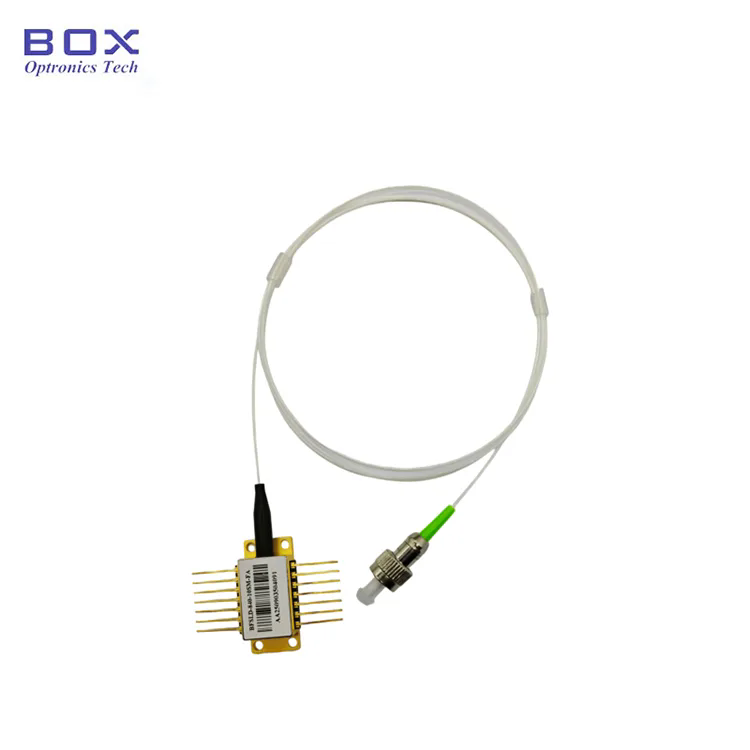
Table of Contents
- 1. Introduction to Distributed-Feedback Laser
- 2. Working Principle Explained
- 3. Internal Structure and Design
- 4. Key Advantages of DFB Lasers
- 5. Industrial Applications
- 6. DFB vs Other Laser Types
- 7. How to Select the Right DFB Laser
- 8. Technical Challenges and Solutions
- 9. Frequently Asked Questions
- 10. Conclusion
1. Introduction to Distributed-Feedback Laser
A Distributed-Feedback Laser is a semiconductor laser that integrates a periodic optical grating directly into the active region of the device. This grating provides wavelength-selective feedback, eliminating the need for external cavity mirrors. The result is a laser that emits a highly stable, single longitudinal mode output.
In modern photonics systems, stability and spectral precision are critical. Industries such as fiber-optic communications, gas sensing, and high-resolution spectroscopy rely on this laser type because it reduces noise, minimizes mode hopping, and ensures consistent performance over long operational periods.
Companies such as Box have developed advanced Distributed-Feedback Laser solutions designed for industrial-grade reliability and precision, addressing the growing demand for compact, high-performance optical sources.
2. Working Principle Explained
The core principle of a Distributed-Feedback Laser is Bragg reflection. Instead of using external mirrors, the device uses a built-in diffraction grating that reflects specific wavelengths while suppressing others.
Step-by-step mechanism:
- Electrical injection excites electrons and holes in the semiconductor active layer.
- Photon emission begins through spontaneous recombination.
- The periodic grating selectively reinforces a specific wavelength through constructive interference.
- Unwanted wavelengths are suppressed due to destructive interference.
- A stable single-mode laser output is achieved.
This internal feedback mechanism ensures that only one dominant wavelength is amplified, making DFB lasers ideal for precision applications.
3. Internal Structure and Design
A Distributed-Feedback Laser is composed of several key structural components that determine its performance characteristics:
- Active Layer: The region where light is generated via electron-hole recombination.
- Bragg Grating: A periodic refractive index variation that provides wavelength-selective feedback.
- Waveguide: Confines and directs the optical signal.
- Cladding Layers: Reduce optical losses and improve confinement.
- Electrodes: Provide current injection for laser operation.
The grating period is precisely engineered to match the desired emission wavelength, which is one of the most critical aspects of DFB laser design.
4. Key Advantages of DFB Lasers
Distributed-Feedback Lasers offer several performance benefits that make them superior in many precision applications:
- Single-Mode Operation: Ensures high spectral purity.
- High Stability: Minimal wavelength drift under temperature variation.
- Narrow Linewidth: Essential for coherent communication systems.
- Compact Design: No need for external cavity components.
- Low Noise: Suitable for sensitive measurement systems.
These advantages make DFB lasers a preferred choice in fiber-optic transmission networks and advanced sensing platforms.
5. Industrial Applications
Distributed-Feedback Lasers are widely used across multiple high-tech industries:
- Optical Fiber Communication: Long-distance data transmission with minimal signal loss.
- Gas Sensing: Detection of CO₂, CH₄, and other gases using absorption spectroscopy.
- Biomedical Diagnostics: High-resolution imaging and sensing systems.
- LiDAR Systems: Precise distance measurement and mapping.
- Industrial Metrology: Precision alignment and measurement tools.
In these applications, laser wavelength stability directly impacts system accuracy, making DFB technology essential for mission-critical operations.
6. DFB vs Other Laser Types
The following table highlights key differences between Distributed-Feedback Lasers and other common laser types:
| Feature | DFB Laser | Fabry-Perot Laser | External Cavity Laser |
|---|---|---|---|
| Mode Structure | Single-mode | Multi-mode | Single-mode (adjustable) |
| Wavelength Stability | Very high | Moderate | High |
| Design Complexity | Medium | Low | High |
| Size | Compact | Compact | Bulky |
| Cost Efficiency | Balanced | Low cost | High cost |
7. How to Select the Right DFB Laser
Choosing the correct Distributed-Feedback Laser depends on application requirements and system integration constraints. Engineers typically evaluate the following parameters:
- Operating wavelength (e.g., 1310 nm, 1550 nm)
- Output power requirements
- Temperature stability range
- Linewidth and coherence length
- Packaging type (butterfly, TO-can, etc.)
Manufacturers such as Box provide customizable DFB laser modules tailored to industrial and scientific use cases, ensuring optimized performance for specific deployment environments.
8. Technical Challenges and Solutions
While Distributed-Feedback Lasers offer superior performance, they also present certain engineering challenges:
- Temperature Sensitivity: Requires precise thermal control systems.
- Manufacturing Complexity: Grating fabrication demands high-precision lithography.
- Cost Factors: Higher production costs compared to basic diode lasers.
- Integration Requirements: Needs careful optical alignment in complex systems.
Advanced manufacturers address these issues through improved epitaxial growth techniques, integrated thermal stabilization, and optimized packaging design.
9. Frequently Asked Questions
Q1: What makes a Distributed-Feedback Laser different from a standard laser diode?
DFB lasers include a built-in grating that enforces single-wavelength emission, while standard laser diodes often produce multiple wavelengths.
Q2: Why is wavelength stability so important?
In communication and sensing systems, even minor wavelength drift can degrade signal quality or measurement accuracy.
Q3: Can DFB lasers operate in harsh environments?
Yes, with proper thermal packaging and control, they can operate reliably in industrial and outdoor environments.
Q4: What industries benefit most from DFB lasers?
Telecommunications, gas sensing, medical diagnostics, and precision instrumentation benefit significantly from this technology.
10. Conclusion
Distributed-Feedback Lasers represent a cornerstone technology in modern photonics. Their ability to deliver stable, single-mode, high-purity light output makes them indispensable in applications requiring extreme precision. As industries continue to demand higher bandwidth, better sensing accuracy, and more compact optical systems, DFB laser technology will remain a critical enabler.
Companies like Box continue to innovate in this field, offering advanced Distributed-Feedback Laser solutions that meet evolving industrial and scientific requirements while maintaining high reliability and performance standards.
If you are exploring high-performance optical solutions or need technical consultation for your photonics application, contact us today to learn how Box can support your project with tailored Distributed-Feedback Laser technologies.