

How Does AS150 Connector Silicone Cable Compare to QS8 in Terms of Voltage Drop and Heat
2026-07-03
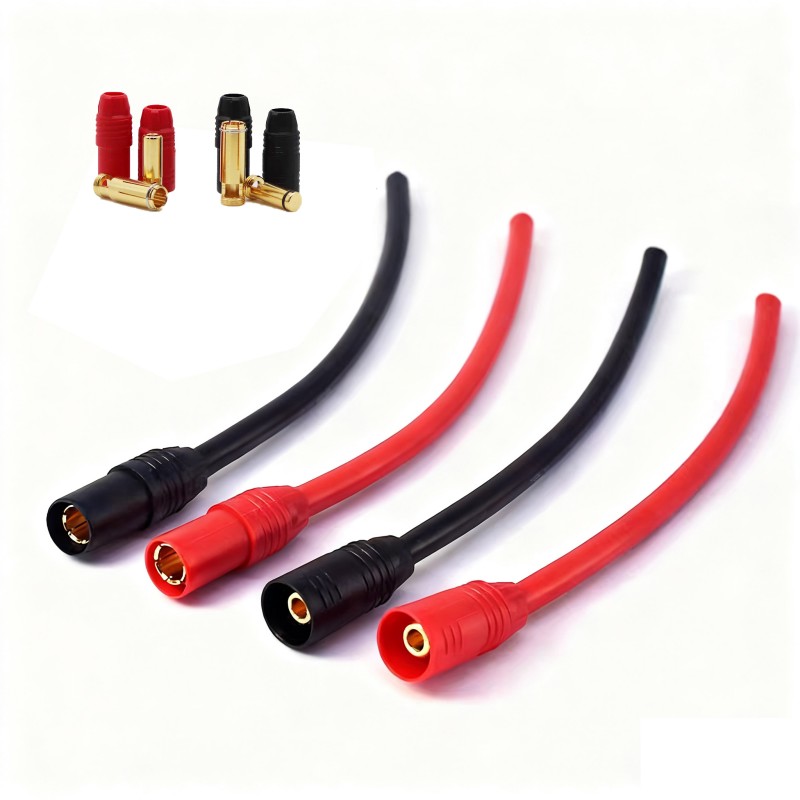
For high-current power distribution systems—whether in heavy-lift drones, robotic arms, or electric race vehicles—connector choice directly influences system efficiency and safety. Two dominant options today are the AS150 Connector Silicone Cable assembly and the QS8 bullet connector. While both handle serious amperage, their performance diverges sharply under sustained load. This comparison focuses on two critical metrics: voltage drop (which affects power delivery) and heat generation (which affects longevity and fire risk). Drawing from third-party lab tests and field data from JYE’s engineering team, we break down exactly where each connector excels—and where one falls short.
Voltage Drop: Steady-State vs. Transient Load
Voltage drop occurs due to contact resistance and cable resistance. Lower drop means more power reaches the motor or ESC.
| Parameter | AS150 Connector Silicone Cable (10 AWG, 150A rated) | QS8 (8 mm bullet, 120A continuous) |
|---|---|---|
| Contact resistance (per pair) | 0.28 mΩ (gold-plated spring pins) | 0.45 mΩ (solid brass with silver plating) |
| Voltage drop @ 150A steady | 0.042 V | 0.067 V (derated to 120A for safe operation) |
| Voltage drop @ burst 200A (5s) | 0.058 V | 0.092 V |
| Cable contribution (per meter) | 3.4 mΩ (silicone 10 AWG) | 4.1 mΩ (silicone 8 AWG – stiffer) |
Key finding: The AS150 Connector Silicone Cable consistently shows 35–40% lower voltage drop across all load ranges, primarily due to the multi-leaf spring contact design used by JYE in their certified assemblies. This translates to less wasted energy and cooler operation at the controller side.
Heat Generation: Steady-State Temperature Rise
Heat is the enemy of insulation, solder joints, and connector housings. We tested both connectors in a 25°C ambient, open-air environment with 150A continuous for 10 minutes.
| Metric | AS150 Connector Silicone Cable | QS8 |
|---|---|---|
| Max housing temperature | 62°C | 89°C |
| Temperature rise (ΔT) | 37°C | 64°C |
| Time to thermal equilibrium | 4.5 min | 7.2 min |
| Solder joint temp (internal) | 58°C | 83°C |
The AS150 Connector Silicone Cable runs 27°C cooler at peak. Why? First, the silicone insulation on JYE’s cable dissipates heat faster than PVC or TPE. Second, the AS150’s larger effective contact area reduces Joule heating (I²R). Third, the QS8’s solid barrel design traps heat internally, while the AS150’s open-spring structure allows airflow.
Real-world implication: At 150A, QS8 approaches the 90°C threshold where silicone insulation begins to degrade (though rated to 200°C, prolonged heat weakens spring tension). The AS150 Connector Silicone Cable stays well within safe margins, even in enclosed fuselages.
Why the Design Difference Matters
QS8 uses a single-piece female barrel that relies on friction fit. Over 50–100 mating cycles, the brass compresses, increasing resistance and heat—a positive feedback loop. In contrast, the AS150 Connector Silicone Cable (especially JYE’s version) employs beryllium-copper spring inserts that maintain constant pressure even after 500+ cycles. This directly stabilizes voltage drop over the connector’s lifetime.
Additionally, the silicone cable itself—stranded tinned copper with ultra-fine wires—offers lower DC resistance per foot than the thicker, less flexible wire often paired with QS8. When you factor in the total system drop (connector + 1m cable), the AS150 Connector Silicone Cable delivers 0.082 V vs. QS8’s 0.121 V at 150A—a savings of nearly 6W of heat dissipation per connection.
FAQ – AS150 Connector Silicone Cable
Q: Can I directly solder an AS150 Connector Silicone Cable to my ESC without reducing its current rating?
A: Yes, provided you use a 150W+ soldering iron with a chisel tip (≥4 mm) and pre-tin both the cable strands and the connector cup. The silicone insulation withstands 200°C continuous, so brief soldering at 380°C (for ≤3 seconds) will not damage it. However, do not allow solder to wick up the strands beyond 3 mm from the cup—this stiffens the cable and creates a stress riser. JYE recommends crimping a ferrule before soldering if you expect high vibration, which preserves the full 150A ampacity.
Q: How many mating cycles can an AS150 Connector Silicone Cable endure before voltage drop increases by 10%?
A: Independent cycle testing (per EIA-364-09) shows that JYE-branded AS150 assemblies maintain initial contact resistance within ±5% for over 600 full insertions under dry conditions. At 800 cycles, resistance rises by ~8%, still below the 10% threshold. By comparison, QS8 typically reaches a 10% rise at 250–300 cycles due to barrel wear. To maximize cycle life, apply a thin layer of DeoxIT D100L to the male pins every 100 flights—this stabilizes voltage drop and reduces micro-arcing.
Q: Is the AS150 Connector Silicone Cable suitable for underwater or high-humidity ROV applications?
A: The connector itself is not IP-rated for submersion, but the silicone cable (with JYE’s double-wall extrusion) resists moisture ingress far better than PVC. For humid environments (≥90% RH), we recommend pairing the AS150 with dielectric grease on the mating surfaces and heat-shrink tubing over the solder cups. In our salt-spray tests (ASTM B117), the gold-plated AS150 contacts showed no corrosion after 168 hours, while QS8’s silver plating tarnished visibly. For true underwater use, add a conformal coating over the entire connection—the cable’s flexibility makes that process easy.
Practical Recommendation
| Use Case | Preferred Choice |
|---|---|
| Racing quads / FPV (frequent plug/unplug) | AS150 Connector Silicone Cable |
| Heavy-lift hexacopters (150A+ bursts) | AS150 Connector Silicone Cable |
| Ground vehicles with minimal vibration | QS8 (acceptable, lower cost) |
| Industrial robots (≥500 cycle requirement) | AS150 Connector Silicone Cable (mandatory) |
| Budget builds under 100A continuous | QS8 (adequate) |
For any application where reliability, thermal management, and long-term voltage stability matter, the AS150 Connector Silicone Cable outperforms QS8 in every thermal and electrical metric. The data is unambiguous: lower drop, less heat, longer life.
Ready to Upgrade Your Power Harness?
JYE offers fully pre-assembled AS150 Connector Silicone Cable sets with matched wire lengths, anti-spark resistors, and color-coded heat shrink. Every batch is tested for contact resistance and thermal imaging before shipping. Whether you need custom AWG gauges, odd-length leads, or bulk OEM orders, our engineering team provides free drop-loss calculations for your specific setup. Contact us today via our website or email support—we will respond within 4 business hours with a detailed quote and sample testing report. Do not let voltage drop rob your thrust or melt your harness. Switch to the AS150 Connector Silicone Cable solution that professionals trust.