

How Does an EtherCAT Laser Marking Controller Improve Precision and Production Efficiency?
2026-11-11
Industrial laser marking has become an essential process for manufacturers that require permanent identification, product traceability, and high-quality surface marking. As production lines become faster and more automated, traditional motion control methods may struggle to maintain consistent synchronization and processing accuracy.
An EtherCAT Laser Marking Controller addresses these challenges by combining real-time industrial communication with coordinated motion control and laser processing management. It helps equipment manufacturers build more responsive, integrated, and scalable marking machines.
This article explains how EtherCAT technology works in laser marking applications, which performance factors matter most, and how manufacturers can select a suitable controller for their production requirements.
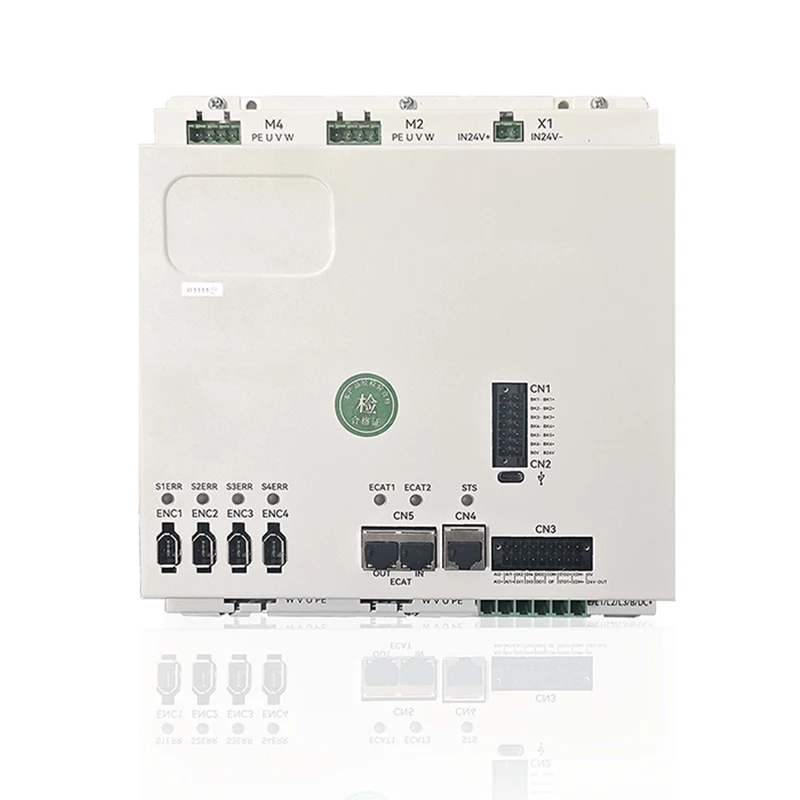
1. What Is an EtherCAT Laser Marking Controller?
An EtherCAT Laser Marking Controller is an industrial control device designed to coordinate laser marking operations and motion systems through the EtherCAT communication protocol. EtherCAT, short for Ethernet for Control Automation Technology, is a real-time industrial Ethernet technology widely used in modern automation equipment.
Unlike conventional control arrangements that may rely on separate pulse signals and multiple independent communication connections, an EtherCAT-based architecture allows compatible devices to exchange control commands and feedback data through an integrated network.
In a laser marking machine, the controller can coordinate several important components, including:
- Laser sources: Generate the laser energy required for marking different materials.
- Galvanometer systems: Direct and position the laser beam along programmed marking paths.
- Servo motors and drives: Control mechanical movement and positioning.
- Encoder feedback devices: Provide position information for motion monitoring and correction.
- Industrial communication devices: Exchange commands and operating information between system components.
- Marking software: Manage processing files, marking parameters, and production instructions.
The main purpose is to make these components work together as a coordinated processing system rather than as disconnected devices.
2. How Does an EtherCAT Laser Marking Controller Work?
The operating principle of an EtherCAT laser marking controller is based on real-time communication, motion coordination, and synchronized execution. It receives processing instructions, distributes commands to connected devices, and uses feedback information to coordinate machine movement.
Step 1: Processing Data Preparation
Before marking begins, the operator prepares the required graphics, text, serial numbers, barcodes, or other marking patterns through compatible marking software.
The software converts the design into processing instructions, including marking paths, movement coordinates, speed settings, and relevant laser parameters.
Step 2: Real-Time Command Transmission
The controller sends motion and processing commands to compatible EtherCAT slave devices, such as servo drives and other supported automation components.
EtherCAT communication is designed for deterministic, low-latency data exchange. This allows connected devices to receive coordinated commands within a controlled communication cycle.
Step 3: Motion Synchronization
During processing, servo drives execute movement commands while the controller coordinates the required axis positions and speeds.
For machines using multiple motion axes, synchronization is particularly important. Poor coordination can cause positioning deviations, uneven marking paths, or inconsistent results across different working areas.
Step 4: Laser Processing Execution
When the motion system reaches the required processing position, the controller coordinates the laser output through the supported laser interface.
Depending on the machine architecture, laser control may include trigger signals, marking synchronization, power settings, and other process-related commands.
Step 5: Feedback and Process Monitoring
Compatible drives and encoder devices return operating information to the control system. The controller can use this information to monitor motion status, identify abnormalities, and support more accurate system operation.
3. Why Is EtherCAT Important for Laser Marking?
Modern laser marking machines are expected to deliver consistent results at increasingly demanding production speeds. When a machine contains multiple axes, galvanometer devices, and automation modules, communication performance becomes an important part of overall equipment capability.
3.1 Faster Real-Time Communication
EtherCAT is designed for high-speed industrial communication. Its real-time characteristics allow control commands and feedback information to be exchanged efficiently between compatible devices.
This is especially valuable in applications that involve frequent position changes, synchronized movement, and continuous production cycles.
3.2 Better Multi-Axis Coordination
Some advanced laser marking machines use multiple servo axes or coordinated mechanical and galvanometer movements. These systems require accurate timing between different motion components.
An EtherCAT control architecture provides a communication foundation for coordinating these devices, helping manufacturers develop more sophisticated motion configurations.
3.3 Simplified Machine Wiring
Traditional equipment may require multiple signal cables connecting individual controllers, drives, and feedback devices. This can increase wiring complexity and make control cabinet layouts difficult to manage.
EtherCAT networking can reduce the number of separate communication connections by allowing compatible devices to share a network infrastructure.
3.4 Improved System Monitoring
With suitable drive and controller support, operating information can be collected and monitored through the communication network.
This helps maintenance personnel identify communication interruptions, drive alarms, and motion-related abnormalities more efficiently.
3.5 Flexible Equipment Expansion
Modular EtherCAT architectures can make it easier to add compatible slave devices and expand machine configurations. This is useful for manufacturers developing different machine models or upgrading existing production equipment.
4. Key Features of an Advanced EtherCAT Controller
Not every EtherCAT laser controller offers the same capabilities. Equipment manufacturers should evaluate the actual hardware, firmware, software, and supported communication functions before choosing a system.
Real-Time Communication
Supports coordinated data exchange between the controller, servo drives, and compatible industrial devices.
Multi-Axis Control
Provides a control foundation for applications requiring coordinated movement across multiple mechanical axes.
Encoder Feedback
Supports position feedback when compatible drives and encoder configurations are integrated into the system.
Modular Architecture
Allows equipment manufacturers to configure different combinations of drives and control modules according to machine requirements.
Fault Diagnostics
Helps identify communication and drive-related abnormalities through supported monitoring and alarm functions.
Integrated Control
Coordinates motion and laser-related operations to support a more unified machine control architecture.
Performance Factors Worth Checking
When comparing different EtherCAT systems, buyers should pay attention to measurable technical specifications rather than relying only on general descriptions.
| Technical Factor | What to Evaluate | Why It Matters |
|---|---|---|
| Communication Cycle | Supported EtherCAT cycle time | Affects control responsiveness and synchronization. |
| Axis Configuration | Number of supported axes | Determines machine configuration flexibility. |
| Encoder Resolution | Compatible encoder types and resolution | Influences feedback measurement capability. |
| Drive Compatibility | Supported EtherCAT servo drives | Reduces integration difficulties. |
| Laser Interface | Supported laser control signals | Ensures reliable coordination with the laser source. |
| Software Support | Marking software and development tools | Determines programming and commissioning efficiency. |
| Diagnostics | Alarm monitoring and fault records | Supports troubleshooting and maintenance. |
5. What Problems Can It Solve in Production?
For industrial manufacturers, investing in a new laser control system is not simply about upgrading communication technology. The real objective is to solve practical production problems and improve equipment performance.
Problem 1: Inconsistent Marking Positions
Positioning errors may occur when motion devices do not receive or execute commands with sufficient coordination. This can result in misplaced characters, distorted graphics, or inconsistent marking positions.
An appropriately configured EtherCAT system can improve communication and synchronization between compatible motion devices, helping reduce control-related positioning deviations.
Problem 2: Complicated Wiring and Installation
Machines with many separate signal connections can require considerable installation work. Excessive wiring also makes troubleshooting more difficult.
An EtherCAT network can simplify communication connections and create a more organized control cabinet layout, provided that compatible devices and suitable network topology are used.
Problem 3: Difficult Equipment Expansion
Manufacturers may need to add additional axes, marking heads, or automation functions when customer requirements change.
A modular control architecture helps make future expansion more manageable. However, the available axis capacity, communication bandwidth, and controller resources must be checked before upgrading.
Problem 4: Time-Consuming Troubleshooting
When a machine stops unexpectedly, technicians need to identify whether the problem comes from the communication network, servo drive, encoder, laser source, or mechanical structure.
Controllers with suitable alarm recording and diagnostic functions can help technicians locate the source of a problem and reduce unnecessary inspection work.
Problem 5: Unstable High-Speed Processing
Increasing marking speed without considering motion response and communication timing may affect processing quality.
EtherCAT technology provides a strong foundation for high-speed coordinated control. Nevertheless, actual marking performance also depends on galvanometer response, servo tuning, mechanical rigidity, laser characteristics, and software optimization.
6. Industrial Applications of EtherCAT Laser Marking
EtherCAT laser marking control systems are suitable for industrial equipment that requires coordinated motion and precise laser processing. Their actual application range depends on the controller configuration and compatible marking hardware.
6.1 Electronic Components and PCB Marking
Electronic manufacturing often requires permanent identification, component codes, product information, and traceability marks.
Laser marking can produce fine text and identification patterns without relying on traditional ink-based printing. An EtherCAT-based control architecture can support accurate positioning and automated production integration.
6.2 Glass and Acrylic Processing
Glass and acrylic processing applications may require detailed patterns, logos, decorative graphics, and identification marks.
For systems involving multiple motion axes or coordinated galvanometer movement, synchronized control can help maintain processing consistency across complex marking paths.
6.3 Textile and Leather Manufacturing
Laser processing is widely used for decorative patterns, logos, product identification, and customized designs in textile and leather industries.
When marking equipment is integrated with automated feeding or positioning systems, coordinated motion control can help maintain the relationship between material movement and marking positions.
6.4 Industrial Product Identification
Manufacturers of machinery, automotive components, and industrial products often require permanent serial numbers, logos, batch codes, and other identification information.
Automated laser marking systems can improve consistency and support integration into production lines where traceability is important.
6.5 Customized Manufacturing
Small-batch production and customized orders require flexible processing instructions. A well-designed control system allows equipment manufacturers to integrate marking programs and motion configurations for different products.
| Industry | Typical Marking Tasks | Important Control Requirements |
|---|---|---|
| Electronics | PCB codes and component identification | Precise positioning and repeatability |
| Glass Processing | Decorative graphics and product logos | Coordinated motion and path accuracy |
| Textile | Patterns and customized designs | Material positioning and synchronization |
| Leather | Logos and decorative marking | Flexible processing and consistent results |
| Automotive | Serial numbers and traceability codes | Stable automated operation |
7. How to Choose the Right EtherCAT Laser Marking Controller
Selecting an appropriate controller is an important decision for laser equipment manufacturers. A system that works well for one machine may not be suitable for another because of differences in axis configuration, laser type, processing speed, and production requirements.
The following considerations can help buyers make a more informed decision.
7.1 Define Your Machine Configuration
Start by identifying the machine's mechanical and electrical architecture.
- How many servo axes are required?
- Does the machine use one or multiple galvanometer heads?
- Is synchronized multi-axis movement necessary?
- Does the system require encoder feedback?
- Will additional modules be added in the future?
These details help determine the required controller capacity and network configuration.
7.2 Check Laser Source Compatibility
Different laser sources may require different control interfaces and signal configurations. Buyers should confirm whether the controller supports the required laser type, trigger method, power control, and synchronization signals.
Do not assume that all laser sources can be connected directly to every EtherCAT controller.
7.3 Evaluate Motion Control Performance
High-speed marking requires more than fast communication. The motion system must also maintain stable acceleration, deceleration, positioning, and synchronization.
Ask the supplier for relevant specifications and test results under conditions similar to your intended production environment.
7.4 Consider Software and Integration
Hardware compatibility is only one part of a complete laser marking solution. Software functions and development support also influence the overall user experience.
Check whether the system provides suitable marking software, parameter configuration, motion programming, communication tools, and technical documentation.
7.5 Evaluate Technical Support
Industrial control systems may require professional support during installation, debugging, and future upgrades.
Choose a manufacturer that can provide clear technical documentation, integration guidance, troubleshooting assistance, and communication with its engineering team.
8. EtherCAT vs. Traditional Pulse Control
Traditional pulse control has been widely used in CNC and laser equipment because of its relatively straightforward architecture. However, more complex automated machines may require additional feedback and communication capabilities.
EtherCAT provides a different control architecture that is particularly useful for systems requiring real-time communication and coordinated motion.
| Comparison Factor | Traditional Pulse Control | EtherCAT Control |
|---|---|---|
| Communication | Pulse and direction signals are commonly used | Industrial Ethernet-based communication |
| Feedback | Depends on drive and feedback configuration | Supports networked feedback from compatible devices |
| Multi-Axis Coordination | May require more independent signal connections | Supports coordinated control over a shared network |
| Wiring | Can involve numerous pulse signal cables | Can simplify communication wiring |
| Diagnostics | Depends on the individual drive and controller | Can provide integrated network and device diagnostics |
| Expansion | May require additional signal connections and hardware | Can support modular network expansion |
| Typical Application | Basic motion control equipment | Advanced multi-axis automation systems |
Neither technology is automatically the best choice for every machine. Traditional pulse control can remain a practical and cost-effective solution for relatively simple applications. EtherCAT is worth considering when a machine requires more integrated communication, extensive feedback, or advanced multi-axis coordination.
9. Installation and Maintenance Considerations
Even a high-performance controller needs correct installation and configuration to achieve reliable operation. Manufacturers should pay attention to the following areas during system integration.
Network Configuration
Use compatible EtherCAT devices, suitable cables, and an appropriate network topology. Follow the manufacturer's instructions for device addressing, network configuration, and communication setup.
Electrical Protection
Separate sensitive communication wiring from high-power cables where appropriate. Apply proper grounding, shielding, and electrical protection measures to reduce electromagnetic interference.
Servo and Encoder Configuration
Confirm motor parameters, encoder settings, drive configuration, and axis direction before starting production. Incorrect settings can cause positioning errors or unexpected machine movement.
Laser Parameter Testing
Test marking speed, laser power, pulse frequency, and other relevant parameters using the actual material. Different materials and surface treatments may require different processing settings.
Regular Maintenance
Inspect cables, connectors, cooling conditions, electrical connections, and device status regularly. Review system alarms and operating records to identify potential issues before they interrupt production.
10. Why Work with an Experienced Laser Control Manufacturer?
Choosing a laser control manufacturer involves more than comparing hardware specifications. Equipment manufacturers also need a supplier that understands laser processing applications, industrial automation, and system integration.
Shenzhen Shenyan CNC Co., Ltd. specializes in motion control systems, industrial automation development, and visual intelligent recognition. Established in 2012, the company integrates research and development, manufacturing, sales, and technical services.
Its product portfolio covers multiple laser control applications, including:
- EtherCAT laser control systems.
- Galvanometer dual-flight laser control systems.
- Multi-axis linkage laser control systems.
- Visual positioning laser control systems.
- Panoramic vision laser control systems.
- Laser cutting and engraving control systems.
- Dynamic galvanometer laser marking control systems.
Integrated Motion Control Solutions
Shenyan's EtherCAT laser control system portfolio is designed for high-speed, high-precision, multi-axis synchronized laser processing applications. Its system architecture integrates multi-axis drive functions and supports modular configurations for different equipment requirements.
According to the company's published technical information, its EtherCAT system series offers configurations including 4-in-1 and 6-in-1 integrated drive arrangements, as well as multiple single-axis drive combinations. The published system specifications also describe support for dual-drive encoder feedback, including compatible absolute encoders of up to 23-bit resolution.
The company reports that its relevant EtherCAT system configurations can reduce wiring requirements by more than 40%, with beam synchronization error below ±3 μm at speeds of up to 120 m/min under specified system conditions.
These figures relate to the described EtherCAT system configurations and should not be assumed to apply identically to every laser marking machine or controller model. Buyers should confirm the applicable configuration and test conditions with the technical team.
Research and Development Experience
With an established R&D team and experience in laser control technology, Shenyan develops solutions for different industrial processing requirements. Its products serve applications involving flexible materials, digital printing, digital labels, glass, acrylic, textiles, leather, and other industrial materials.
Support for Equipment Manufacturers
Different laser equipment manufacturers often have different mechanical structures, processing requirements, and automation configurations. Working with a specialized control system supplier can help simplify technical communication and identify suitable integration options.
For equipment builders looking to develop high-speed marking machines or upgrade existing control architectures, Shenzhen Shenyan CNC Co., Ltd. offers a range of laser control technologies worth exploring.
Learn more about its EtherCAT Laser Control System and other industrial laser control solutions.
11. Frequently Asked Questions
Q1: What is the main function of an EtherCAT Laser Marking Controller?
Its main function is to coordinate laser marking operations and compatible motion devices through real-time industrial communication. It helps manage movement commands, device synchronization, and laser-related control signals.
Q2: Is EtherCAT suitable for high-speed laser marking?
Yes. EtherCAT is designed for real-time industrial communication and is suitable for high-speed automation applications. Actual marking speed and quality depend on the controller, laser source, galvanometer, mechanical system, and processing parameters.
Q3: Can an EtherCAT controller support multiple servo axes?
Yes, provided that the controller and its connected EtherCAT drives support the required axis configuration. The maximum number of axes and synchronization capabilities should be confirmed before purchase.
Q4: What is the difference between EtherCAT and pulse control?
Pulse control generally transmits movement commands through pulse and direction signals, while EtherCAT uses an industrial Ethernet network to exchange control and feedback data. EtherCAT can offer more integrated communication and diagnostic capabilities for complex systems.
Q5: Does an EtherCAT Laser Marking Controller improve marking accuracy?
It can help improve control consistency and motion synchronization when correctly configured. However, final marking accuracy also depends on mechanical precision, optical performance, encoder feedback, servo tuning, and laser processing conditions.
Q6: Which laser sources can work with an EtherCAT laser controller?
Compatibility depends on the controller's laser interface and supported signal configuration. Buyers should confirm the laser source type, trigger requirements, power control method, and synchronization functions with the manufacturer.
Q7: Can an EtherCAT control system be expanded in the future?
Many EtherCAT systems support modular expansion through additional compatible slave devices. However, the available communication capacity, controller resources, and supported device configurations must be evaluated before expansion.
Q8: Is an EtherCAT controller suitable for both laser cutting and marking?
EtherCAT is a communication technology that can support different types of laser equipment. Whether one controller can handle both cutting and marking depends on its hardware interfaces, software functions, and machine configuration.
Q9: What information should I prepare before requesting a quotation?
Prepare your laser source model, machine configuration, required number of axes, galvanometer information, processing materials, target speed, and any special synchronization requirements. These details help the supplier evaluate compatibility and recommend an appropriate solution.
Q10: Why should I choose a specialized laser control system manufacturer?
A specialized manufacturer can provide application-related technical knowledge, hardware and software integration guidance, product configuration recommendations, and support during equipment commissioning.
12. Conclusion
An EtherCAT Laser Marking Controller provides an advanced control foundation for industrial laser marking equipment that requires real-time communication, coordinated motion, and reliable system integration.
By combining compatible servo drives, encoder feedback, laser interfaces, and industrial networking, manufacturers can develop more flexible and efficient marking machines. The benefits are particularly valuable in applications involving multiple axes, high-speed processing, and automated production.
However, choosing the right controller requires a complete evaluation of machine architecture, laser compatibility, motion performance, software functions, and technical support.
With experience in laser control systems and industrial automation, Shenzhen Shenyan CNC Co., Ltd. provides a range of solutions for equipment manufacturers seeking reliable and integrated laser processing control technologies.
Looking for a Reliable EtherCAT Laser Marking Controller?
Are you developing a new laser marking machine or upgrading an existing motion control system? Shenzhen Shenyan CNC Co., Ltd. can help you explore suitable laser control solutions based on your equipment configuration and production requirements.
Contact us today to discuss your application, technical requirements, and customized control system needs. Let our team help you find a suitable solution for your industrial laser marking equipment.
Contact Us for More Information