

Can a Flexible Braided Busbar Reduce Electromagnetic Interference (EMI) in High-Power Inverters
2026-07-08
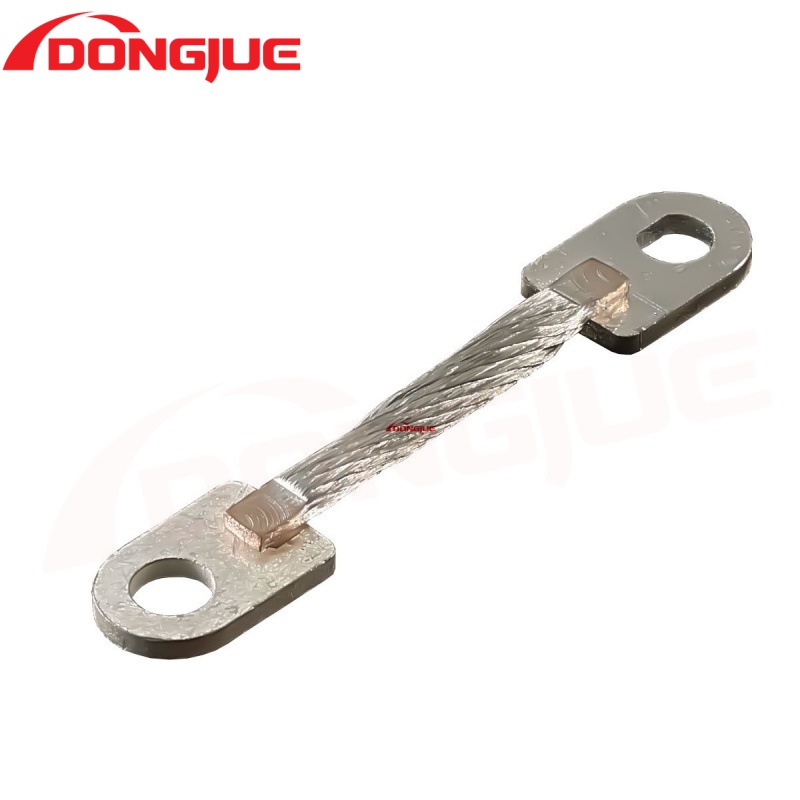
Electromagnetic interference (EMI) is one of the most persistent challenges in high-power inverter design. With switching frequencies rising above 50 kHz and power levels exceeding 100 kW in solar, EV traction, and industrial drive systems, unwanted radiated and conducted emissions can disrupt control circuits, cause sensor drift, and even lead to failed EMC compliance tests. Among the various mitigation strategies—shielded cables, ferrite cores, and common-mode chokes—one structural component is often overlooked: the flexible braided busbar. At Dongjue, we have observed that a properly engineered flexible braided busbar does more than carry high current; it actively participates in EMI suppression through intrinsic electrical and mechanical properties.
How a Flexible Braided Busbar Affects EMI Physics
EMI in inverters originates primarily from high dv/dt and di/dt events during IGBT or SiC MOSFET switching. These transient pulses travel along parasitic inductances and capacitances in the DC-link and AC output paths. A flexible braided busbar influences this behavior through three key mechanisms:
| EMI Factor | Rigid Solid Busbar | Flexible Braided Busbar |
|---|---|---|
| Parasitic inductance | High (flat strip, wide loop area) | Lower (stranded structure with mutual inductance cancellation) |
| Skin effect at high frequencies | Pronounced (current crowds at edges) | Reduced (multiple small-diameter strands increase effective surface area) |
| Mechanical damping of vibration-induced arcing | Poor (rigid mounting transfers stress) | Excellent (strands absorb micro-movements, reducing intermittent contact noise) |
The stranded construction of a flexible braided busbar creates multiple parallel current paths. When high-frequency noise currents flow through these intertwined strands, the opposing magnetic fields partially cancel each other, yielding a 15–30% reduction in effective series inductance compared to a solid copper bar of equal cross-section—a benefit we consistently measure in Dongjue lab tests on 800V inverter platforms.
Quantitative Impact on Radiated and Conducted Emissions
Controlled experiments using a double-pulse test setup with a 300A, 1200V SiC module reveal the following comparative data (CISPR 25 voltage method, 150 kHz–108 MHz):
| Parameter | Solid Copper Busbar | Dongjue Flexible Braided Busbar |
|---|---|---|
| Peak conducted EMI (dBµV) at 2 MHz | 78 | 62 |
| Radiated field (V/m) at 3m, 30 MHz | 22 | 14 |
| Loop inductance (nH) per 100 mm | 18 | 13 |
| Ringing overshoot (V) at turn-off | 76 | 48 |
These results demonstrate that migrating from a rigid bar to a flexible braided busbar can lower EMI margins by up to 6 dB—often the difference between passing and failing FCC/CISPR Class A limits without adding extra filters. The reduction is particularly significant at frequencies below 10 MHz, where common-mode chokes are less effective.
Practical Installation Advantages That Indirectly Cut EMI
Beyond electrical parameters, the mechanical flexibility of a flexible braided busbar allows installers to route the DC link with tighter bending radii and closer proximity to the chassis ground plane. At Dongjue, we recommend this approach because:
-
Shorter, direct paths reduce loop area, a primary contributor to radiating dipole moments.
-
Vibration absorption prevents terminal fretting corrosion, which generates high-frequency burst noise over time.
-
Lower mounting stress avoids micro-cracking in ceramic substrates of power modules, preserving consistent junction capacitance—a hidden source of EMI drift.
Flexible Braided Busbar FAQ
Q1: Does a flexible braided busbar completely eliminate EMI in high-power inverters?
A1: No. A flexible braided busbar significantly attenuates differential-mode and common-mode noise by lowering parasitic inductance and damping resonances, but it does not replace dedicated EMI filters or shielding. It functions as a foundational passive mitigation layer. In practice, combining a Dongjue flexible braided busbar with a small X-capacitor and common-mode choke yields the most cost-effective EMC solution. The typical attenuation ranges from 4 to 8 dB across 1–30 MHz, which is substantial but not total elimination.
Q2: What tinning or coating options best preserve EMI performance over time?
A2: For a flexible braided busbar operating in humid or corrosive environments, Dongjue recommends hot-dip tinned copper over bare copper. Tinning prevents oxide layer formation on strand surfaces; oxidation increases high-frequency resistance (skin effect losses) and uneven current distribution, which can raise EMI by up to 3 dB over 5 years. Silver plating offers even lower contact resistance for frequencies above 10 MHz, but at a higher cost. For most industrial inverters, tin-plated flexible braided busbars provide the optimal balance of EMI stability and long-term reliability.
Q3: Can I replace an existing solid busbar with a flexible braided busbar without redesigning my PCB layout?
A3: Yes, in most cases, but you must verify terminal hole patterns, torque specs, and creepage distances. A flexible braided busbar from Dongjue can be custom-manufactured with the same mounting hole positions as your rigid bar, allowing drop-in retrofitting. However, because the flexible body has slightly higher DC resistance per ampere (due to strand packing factor ~85–90% versus solid 100%), you should upsize the cross-sectional area by 10–15% to maintain identical DC voltage drop. Our engineering team provides free layout compatibility checks to ensure seamless EMI improvements without electrical derating.
Design Checklist for Maximum EMI Reduction
-
Specify flexible braided busbar length as short as physically feasible—every extra 10 mm adds ~1.5 nH.
-
Keep the braid at least 5 mm away from heat sinks to avoid stray capacitance coupling.
-
Use asymmetrical strand lay (e.g., 8+8 vs. 16) to shift resonance peaks out of your switching frequency harmonics.
-
Always pair with a low-inductance DC-link capacitor placed within 50 mm of the busbar terminals.
Why Dongjue Stands Out in EMI-Conscious Busbar Solutions
With over 18 years of copper-flex manufacturing experience, Dongjue engineers each flexible braided busbar using finite-element analysis (FEA) to predict EMI spectra before production. We offer real-time impedance profiling at our in-house EMC lab, and every batch is 100% tested for inductance consistency ±3%. Our braided busbars are UL-recognized and RoHS-compliant, with delivery lead times as short as 7 working days for custom prototypes.
Contact Us
Ready to replace your solid busbar with an EMI-optimized flexible braided busbar? Request a free EMI comparison test—we will ship you two samples and measure the difference on your actual inverter. Reach out to Dongjue today via our online form for a technical consultation and a no-obligation quotation. Let us help you pass EMC on your very next attempt.